Hello, everyone. This is the station chief.This article is mainly about the creation of this station.
This station was first set up in March 2026 by me, "Students who don't know how to play games" .Drayee_flySimilarOpen Source ProjectInspired by the fact that I am very fond of Cosmic Prince Kaguya's animated work and the Agent concept. I'm not born in class, I'm just a little tan for code, and I built a very original site with openclaw and previous experience of flying oxnas.
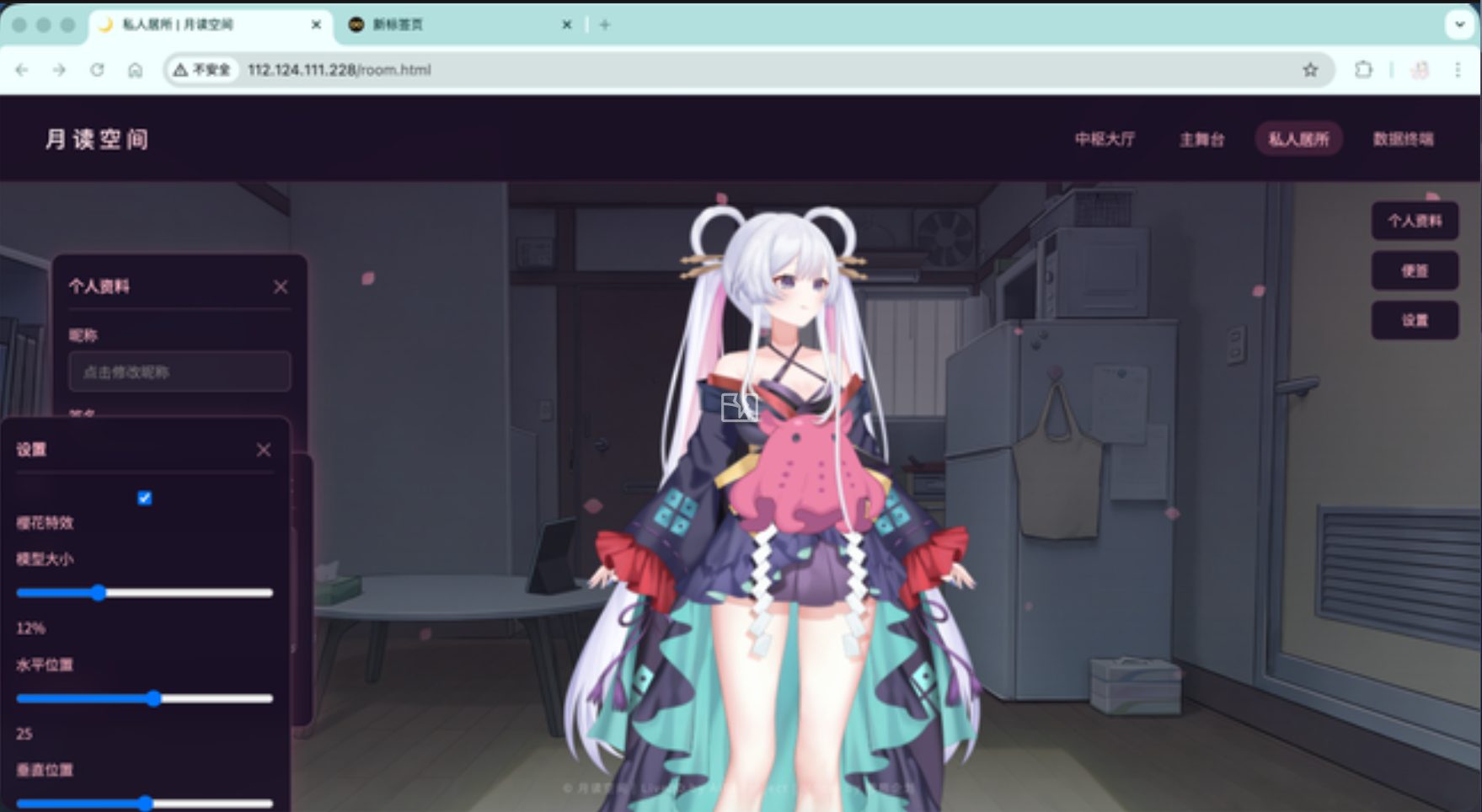
Since then, I have returned to school because of the need to write thesis to open up the Gpt Plus membership and to use the codex, and the pace of development has increased considerably. To date, all work streams have been converted to codex development, supported by manual reviews.
When Tsukuyomi Space's basic framework was completed, it came up with important questions -- nobody used them...
So, on May 5th, I released the first video of the Tsukuyomi Space site on site b.Video Link
Video traffic is good. It attracts some users and creates a QQC group, laying the groundwork for subsequent development.
The period that followed was dominated by grinding of details on the Tsukuyomi Space site, including load speed, ui design (until now being optimized), web performance, etc., which yielded some results.
I've tried a number of other topics during this period, including the direction of angent, and when the main subject of llm controlling live2d, I've had some success, and I've got this video.VideoThe relevant warehouses are as follows:GitHub
The video got good data, and I got a lot of help and a lot of users.
Since I graduated from school, I have had ample time, and I have continued to optimize the site, with access to the library, pixels, etc., and the ease of use of the site has been increasing, as well as supporting the three-party Oouth access.
At the same time, I have started to develop a new project, angent-os, aimed at creating a web-os that Ai's assistant inherited in depth like a bean-bag cell phone. The project was set up on 3 July. After two weeks or so of the completion of the project infrastructure, the following video was made available on the official Tsukuyomi Space site:agent-os
In the future, I will continue to optimize the Tsukuyomi Space site, bringing more functionality and easier operation, and Yachiyo will always be here.
Here's a description of Tsukuyomi Space's structure.
"Tsukuyomi Space" is based on "Cosmic Prince Kaguya!" Worldview constructs an immersive personal digital space that integrates individual content publication, community interaction, virtual role companionship, artificial intelligence, user management and light-weight creative tools into a unified Web application. The system has as its main navigational portal the Main Stage article system, the Monthly Reading Plaza, Live2D private rooms, user centres, library and attachment management, alumni chain system, in-station notifications, administrator terminals and pixels workshops, and forms an integrated platform with both individual websites, content communities and virtual role interaction.
The project uses Vue 3, Vue Router and Vite to build a single page to use the front end of the page to increase the speed of the page and the access experience by routing, preheating the page component and harmonizing SEO metadata management. At the front end, a design system consisting of design variables, thematic systems, generic components, animated norms and responsive layouts has been established to support dark and light themes and to maintain consistency between different pages with a daily clean-up, aggregated glass and a secondary visual style. The front end of the system is a full business scene of content browsing, article editing, voicemail interaction, user home page, library, alert, Live2D room, back-office terminal and pixel creation.
The backend is based on Node.js and Express for the construction of RESTful API, which is stored as the main relationship data using better-sqlite3 and organized according to route layers, service layers, storage reservoirs, intermediates and database migration modules. The system provides interfaces for user registration, mailbox authentication, JWT identification, article management, voicemail responses and comments, access statistics, resource uploads, friend chain applications, pixels, AI dialogue, voice synthesis and backstage management. Ordinary users and administrators use a separate identity link and token system, where service-end performance privileges are based on roles such as user, admin and super admin, and avoid relying solely on front-end pages to hide into a secure boundary.
Live2D private room is the core feature module of the project. The module combines Live2D Cubism role presentations with large-language models, TTS speech synthesis, weather and time environments, music play, role knowledge base, MCP tool call-up and long-term memory mechanisms, enabling virtual role generation of continuous individualized responses based on user information and the current environment. The login user's long-term memory is SQLite as an authoritative source of edited data, and vector indexing and semantic retrieval can be done through Milvus; without login users use the browser for local storage. The system also supports Yachiyo linguistic import, isolation of user memory, the failure of synchronisation of vectors and a comprehensive search strategy that integrates similarities, time, importance and memory types, thus enhancing role personality stability and long-term interactivity.
In terms of security and stability, the system has mechanisms such as a security response head, a white list of CORS sources, credible writing requests for verification, repetition of JSON key detection, stratification interface limit, volume limitation of requests, passwords for Hashi and JWT clearance. Redis can be used for authentication codes, restricted flow, weather caches, log-in failure and token blacklists, and back to process memory if not available. The database uses a version-based migration mechanism to deploy scripts to automatically back up SQLite data before it is updated in order to reduce data risks from upgrades and structural changes.
The project supports the Docker Compose containerization deployment, which is also compatible with the PM2, Nginx and SSH deployment programmes. Packagings are operated using a read-only file system, removal of permissions, prohibition of rights enhancement, permanentisation of data sheets, health checks and log rotation configurations, which can combine Redis, Milvus, etcd and MinIO into a complete Agent memory infrastructure. The project uses node: test to complete interfaces, privileges, security and front-end logical tests, and Playwright to validate key business processes and complete engineering processes from development, testing, construction to production deployment.
In summary, Tsukuyomi Space upgrades traditional personal websites to immersed digital spaces with content management, social interaction, virtual companionship, long-term memory and tools mobilization capabilities through modular Web architecture, role-driven interactive design and scalable Agent capabilities. Not only does the project reflect modern global Web development, containerization deployment and security control Technology, it also provides a practical realization programme for the integration of Live2D virtual role and large language models into personal digital space.
Key words: Tsukuyomi Space; Vue 3; Node.js; Express; Live2D; Big Language Model; Smart Age; Long-Term Memory; Milvus; Docker